We've sent you an email with a link to update your password.
Reset your password
We will send you an email to reset your password.
Whey Protein vs Casein: What's the Difference and Which Should You Choose?
Jyoti Vashisth
0 comments
Whey and casein are both milk proteins. Whey generally delivers amino acids into the blood more quickly, while casein forms a gel in the stomach and is digested more gradually. Both can contribute to your protein intake. The better choice depends on your diet, preferences and routine, rather than speed alone.
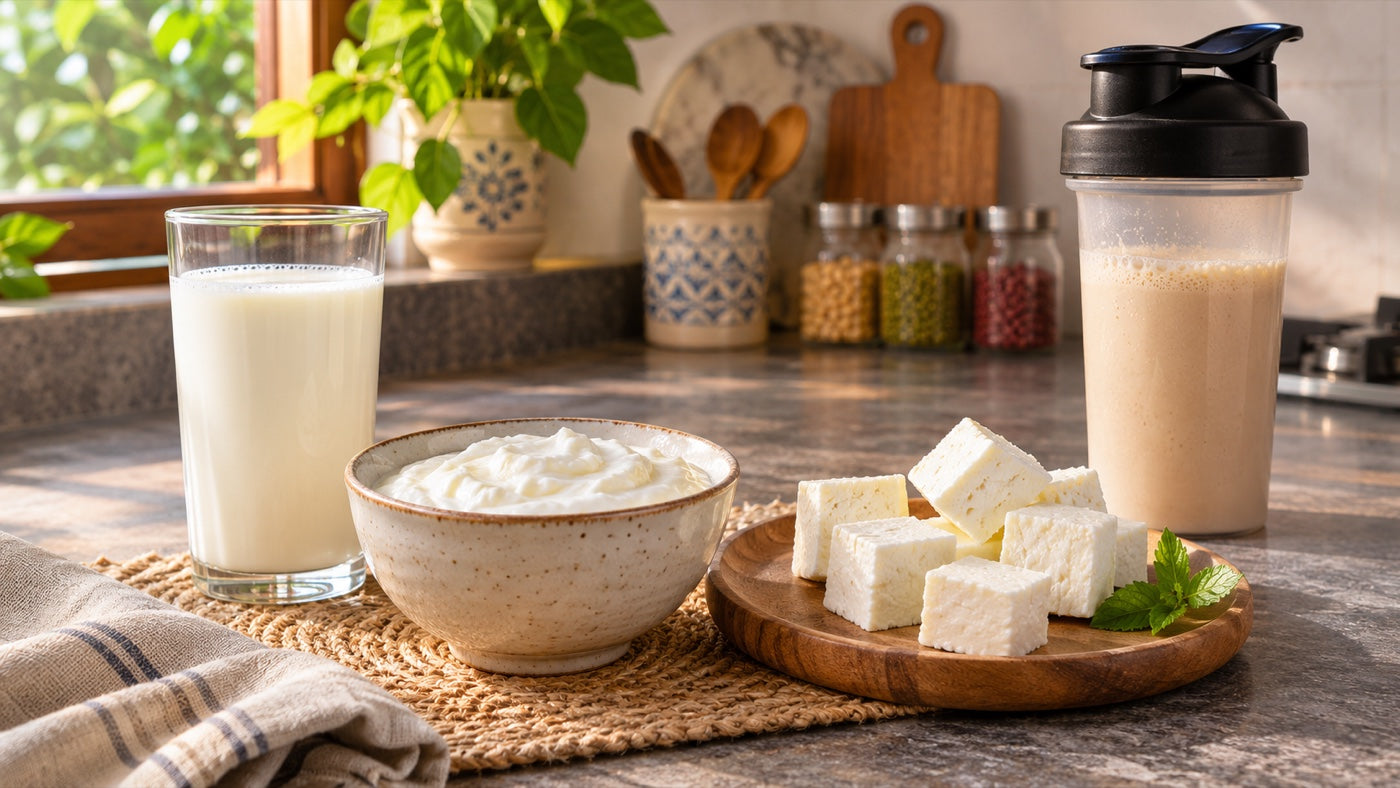
Milk contains both groups of proteins. During cheesemaking, much of the casein becomes part of the curd, while whey proteins remain in the liquid. Further processing produces ingredients used in protein powders.
Casein powder is often sold as micellar casein. Whey powder may use concentrate, isolate, hydrolysate or a blend. Those names describe ingredients and processing; they do not tell you everything about the finished flavoured serving.
Curd, milk and paneer are useful dairy foods, but they are not interchangeable with a measured serving of purified casein or whey. Their protein, fat and energy depend on the food and portion.
Buying question
Whey protein
Casein protein
Digestion pattern
Generally faster amino-acid delivery
Generally more gradual amino-acid delivery
Common texture
Often thinner when mixed with water
Often thicker, depending on the recipe
Practical use
A convenient portion around meals or training
An option when you prefer a thicker drink or evening portion
Contains milk protein?
Yes
Yes
Automatically lactose-free?
No
No
Whey and casein have different digestion patterns; neither is suitable for milk allergy.
Does faster mean more muscle?
Not by itself. Digestion studies measure what happens after a particular serving under controlled conditions. They do not establish that the fastest powder will produce the most muscle over months of training.
Yves Boirie and colleagues helped develop the fast-and-slow protein concept in their 1997 metabolic study. The distinction concerns the pattern of amino-acid availability and protein metabolism after feeding. It is not a rule that whey is always better, or that casein must be taken every night.
For a useful comparison, keep the protein portion, training and overall diet in view. A well-chosen powder cannot compensate for repeatedly missing meals or an inconsistent training programme. Our guide to protein qualityexplains why amino-acid supply and digestibility both matter.
Where One Science Nutrition Premium Whey fits
One Science Nutrition Premium Whey combines whey concentrate and isolate. Chocolate Charge provides 25 g protein per 32.5 g serving, with 117 kcal. It is a practical choice when you include dairy and want a defined protein portion without preparing another cooked snack.
Choose One Science Nutrition Premium Whey for a gap you can name: a rushed morning, a delayed meal after training, or a day when your usual food falls short. You do not need to reserve it for one exact minute after exercise. Mix according to the pack and count any milk or other additions separately.
One Science Nutrition Premium Whey contains milk and soy. It is unsuitable for milk allergy and is not recommended for children or during pregnancy or breastfeeding.
Where One Science Nutrition ISO Gold fits
One Science Nutrition ISO Gold combines whey isolate and hydrolysed whey. Its Chocolate formula provides 27 g protein per 32.5 g serving, with 113 kcal, 0.5 g carbohydrate and 0.3 g fat.
Consider One Science Nutrition ISO Gold when you prefer that formula and its serving nutrition. The higher protein amount in this serving is a concrete difference you can compare. It does not prove greater muscle growth than every other suitable protein source.
One Science Nutrition ISO Gold remains milk-derived. It is unsuitable for milk allergy and is not recommended for children or during pregnancy or breastfeeding. Low carbohydrate content alone does not establish that a product is lactose-free.
Do you need whey in the morning and casein at night?
No. You can meet protein needs through ordinary meals, a suitable supplement, or both. Buying two types is optional. If you prefer casein's thicker texture, that can be a reasonable personal choice; if a whey serving fits your evening routine, the clock does not make it the wrong protein.