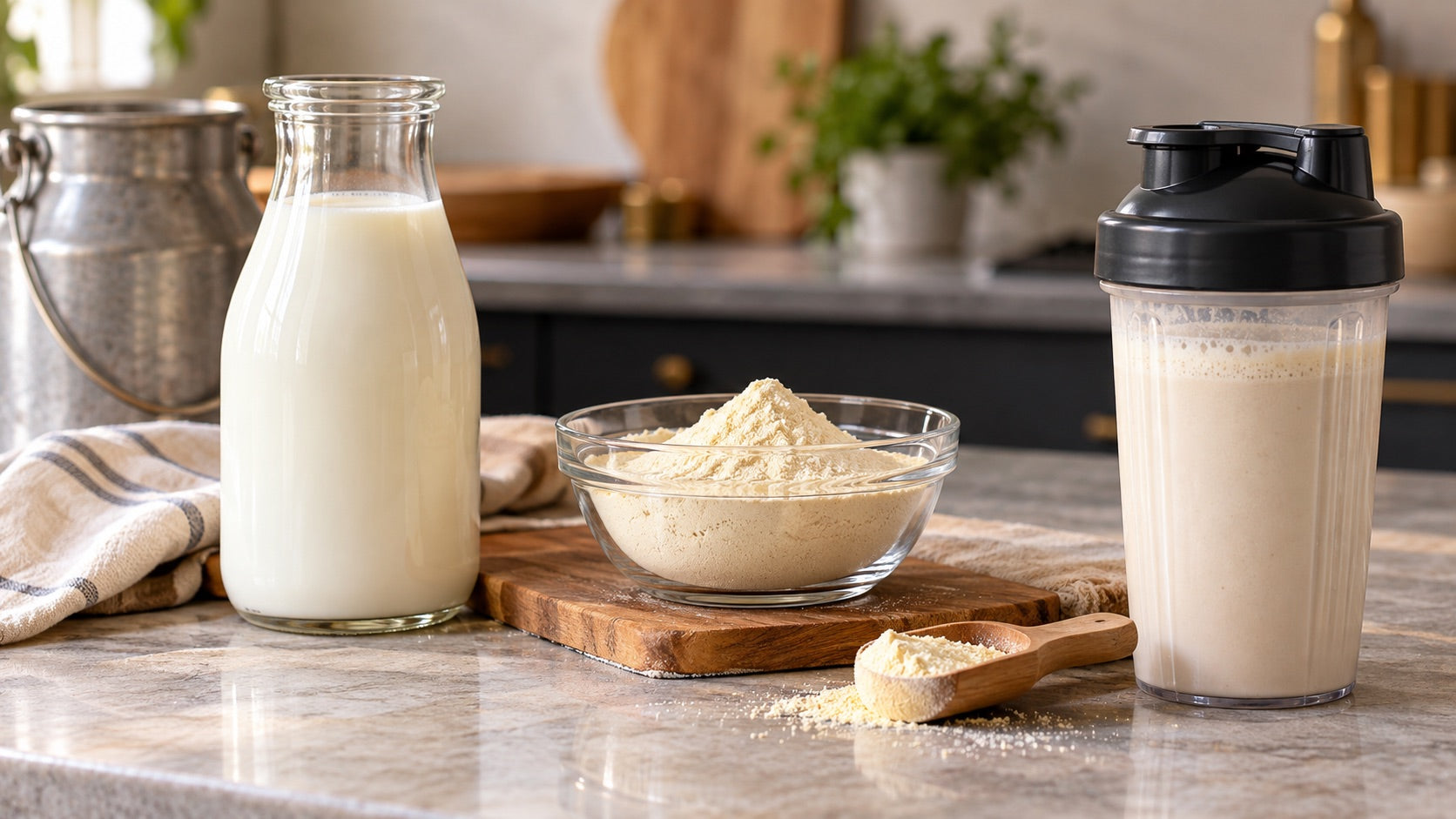
Whey protein is a protein source derived from milk. Manufacturers separate and process the whey portion to make ingredients used in protein powders and other foods. Whey contains the essential amino acids needed from the diet. It can be a convenient way to add protein when meals do not provide enough, but it is not a requirement for everyone. Cleveland Clinic explains whey and its uses.
To compare two whey protein options, start with One Science Nutrition Premium Whey and One Science Nutrition ISO Gold. Their labels show which protein forms they contain and how much protein each serving provides. One Science Nutrition Premium Whey offers a concentrate-and-isolate blend; One Science Nutrition ISO Gold offers isolate and hydrolysate with less fat and carbohydrate in its chocolate serving.
What is whey protein made from?
Milk contains different proteins, including whey and casein. During cheese making, the liquid whey separates from the curds. Processing can concentrate the proteins in that liquid and turn them into powder ingredients. Hoffman and Falvo describe whey processing in their review.
The liquid left after making paneer can help you picture that separation. It is not nutritionally equivalent to a measured serving of commercial whey powder. Processing removes water and separates components to make a concentrated protein ingredient.
Whey comes from milk, so it is not vegan. If your vegetarian diet includes dairy, its milk source may fit your preferences. Check the finished product's other ingredients too.
“Whey” also names the protein source, not every ingredient in a finished product. Flavourings, sweeteners and other additions depend on the formulation. Read the whole ingredient list.
What are the main types of whey protein?
Whey concentrate, isolate and hydrolysed whey differ in processing. Finished powders may contain one type or a blend.
| Type |
What changes |
What to check on the finished product |
| Concentrate |
Protein is concentrated from whey, with some other milk components retained |
Protein per serving, carbohydrates, fat and ingredients |
| Isolate |
Further separation increases the protein proportion of the ingredient |
Actual serving nutrition and any lactose claim |
| Hydrolysed whey |
Some protein bonds are broken during processing |
Which protein source was used and whether the product fits your needs |
| Blend |
More than one protein ingredient is combined |
The ingredient list rather than the front label alone |
Cleveland Clinic discusses the different whey forms. These descriptions do not establish that one form always produces better results. A flavoured powder's final nutrition is what you actually consume.
One Science Nutrition Premium Whey combines concentrate and isolate. One Science Nutrition ISO Gold combines isolate and hydrolysate in its chocolate formula. The ingredient lists show which whey types are combined in each product.
What does whey protein do, and what benefits can it offer?
Whey provides dietary protein in a convenient format. Its usefulness depends on the person and the rest of the diet.
For someone who struggles to prepare meals around work or training, a powder can make an identified protein gap easier to cover. For someone already meeting their requirements through food, convenience may be the main reason to use it rather than a need for more protein.
Protein also matters in a training programme. NIH ODS explains its role in supporting the body's response to exercise. That does not mean a shake replaces the training itself.
Suppose your food log provides 85 g against an appropriate 110 g target. The 25 g protein serving of One Science Nutrition Premium Whey would bring that example to 110 g. It is a convenient way to implement the plan, not a recommendation that everyone needs 110 g or an extra shake. One Science Nutrition ISO Gold's 27 g protein serving offers another contribution to count against your own target.
Does whey protein build muscle by itself?
Building muscle takes resistance training, enough protein and a routine you can repeat. Whey can help supply the protein part of that plan.
In their 2018 meta analysis, Morton and colleagues studied protein supplementation alongside resistance training in healthy adults. The results support using protein alongside resistance training. Drinking whey without that training is a different situation. Read the study.
Keep an eye on your workouts, meals and recovery together. A shake can help with protein, but it cannot replace a training routine.
How does whey protein work after you drink it?
Whey goes through digestion like other dietary proteins. Proteins are broken down into smaller components, including amino acids, which are absorbed and used within the body. NIDDK explains how dietary protein is digested.
Avoid reading “fast” on a label as “more muscle”. Digestion speed is one characteristic. It does not, by itself, establish a better long term outcome for your routine.
The more practical checks are what the serving contains, how it fits your total intake and whether you tolerate it.
One Science Nutrition Premium Whey or One Science Nutrition ISO Gold: how should you use your whey protein?
Follow the directions for the specific product. Serving weights and ingredients vary, so a scoop count borrowed from another powder is a poor starting point.
Check these details before you make the first shake:
- The serving weight and protein per serving.
- The ingredient and allergen list.
- Directions and any product warnings.
- How the drink fits your existing meals.
- Whether your chosen mixer changes the overall nutrition.
If you mix whey with milk rather than water, count the milk too. If you add banana, oats and peanut butter, you have changed the drink's ingredients and nutrition. That may fit your goal. Just do not track it as though you drank powder and water alone.
Compare two One Science Nutrition whey protein formulas
| Per powder serving |
One Science Nutrition Premium Whey, Chocolate Charge |
One Science Nutrition ISO Gold, Chocolate |
| Powder per serving |
32.5 g |
32.5 g |
| Protein |
25 g |
27 g |
| Energy |
117 kcal |
113 kcal |
| Carbohydrate |
1.6 g |
0.5 g |
| Fat |
2.1 g |
0.3 g |
| Protein ingredients |
Concentrate and isolate |
Isolate and hydrolysate |
The table compares Chocolate Charge with chocolate. Nutrition may differ in other flavours.
Choose One Science Nutrition Premium Whey for a concentrate-and-isolate blend
One Science Nutrition Premium Whey provides 25 g protein per serving on the Chocolate Charge label in a formula with alpha-amylase and papain. Its options include Chocolate Charge, Cafe Mocha and Vanilla Swirl. Choose it when a dairy-based blend fits your diet and you want a flavour you can use in an ordinary protein routine. Milk and soy are declared allergens.
The label uses 32.5 g powder in 150 to 200 ml liquid. Explore One Science Nutrition Premium Whey's flavours and check the serving weight on your chosen pack.
Choose One Science Nutrition ISO Gold when its protein and calories fit your plan
One Science Nutrition ISO Gold provides 27 g protein, 0.5 g carbohydrate and 0.3 g fat in its chocolate serving. Choose it when you want more protein and less carbohydrate and fat per 32.5 g of powder than the Chocolate Charge serving of One Science Nutrition Premium Whey.
The chocolate formula includes isolate and hydrolysate, plus alpha-amylase and papain. Its directions use one 32.5 g serving in 150 to 200 ml liquid per day. Check One Science Nutrition ISO Gold's current flavour and serving details before making that choice.
One Science Nutrition brings European formulation expertise to protein choices for Indian fitness routines. Choose the blend and flavour that fit your daily plan.
Who should be careful with whey protein?
Whey comes from milk. Milk allergy and lactose intolerance are different conditions: allergy involves an immune response to milk proteins, while intolerance concerns difficulty digesting lactose. NIDDK explains that distinction.
Choosing isolate does not make whey an appropriate solution to milk allergy. Do not assume a whey product is suitable just because its lactose content is lower. Read the label and follow professional advice relevant to the condition.
Both featured products are not recommended for children or pregnant or breastfeeding women. Anyone following a medical diet should check whether a supplement fits their prescribed plan.
How do you decide whether whey is worth buying?
Start with three questions. What protein do your meals already provide? What gap remains? Is whey a suitable and convenient way to cover it?
Then compare the actual label, serving count and dietary suitability. You do not need to know every manufacturing term. Focus on the protein you need, the label and a product you can use regularly.
Choose the whey protein format for your next routine: One Science Nutrition Premium Whey for the concentrate-and-isolate blend, or One Science Nutrition ISO Gold when its chocolate serving's protein and calories fit your needs. Read the chosen flavour's complete label and follow its directions.
For current packs and flavour options, browse the One Science Nutrition protein range, then check the selected product’s ingredients and serving nutrition.